
May 15, 2026

There’s a scene near the end of the movie “The Notebook” that stays with people long after the credits roll. Noah, aging and sharp-minded, sits beside his wife, Allie, in the care home where she lives. She has Alzheimer’s. She doesn’t always know his name. But he reads their love story to her every day. And sometimes, in a flash of clarity, she comes back to him. They dance. They hold each other. While his grown adult children ask him to come home, he insists that his preference is to spend as much time as he can with his wife in the safety and comfort of her memory care community.
It’s fiction, yes. But it points to something deeply true: The people we love are part of what keeps us well. And when one partner’s care needs change, staying together isn’t just a romantic ideal—it’s one of the most health-protective decisions a couple can make.
What the research says
Studies consistently show that older adults who remain with their spouses enjoy measurably better health outcomes than those who live apart. Research published in the Journal of Gerontology found that married couples living together have stronger cognitive resilience, lower rates of depression, better medication adherence, and more robust immune function. Married older adults are up to 20% less likely to develop dementia than their single counterparts, a protective effect that persists even when one partner has significant health challenges.
The mechanism isn’t complicated. A spouse notices when you seem off. They encourage you to eat, sleep, and take your medication. They provide touch, routine, and the kind of calm that only decades of shared life can create. Researchers call this “co-regulation,” because long-partnered people help stabilize each other’s nervous systems, mood, and even physiology.
When care needs change
The challenge many couples face is that health doesn’t change at the same pace for both people. One partner may develop memory challenges. One may need physical support while the other is entirely independent. For a long time, this disparity felt like an unavoidable fork in the road.
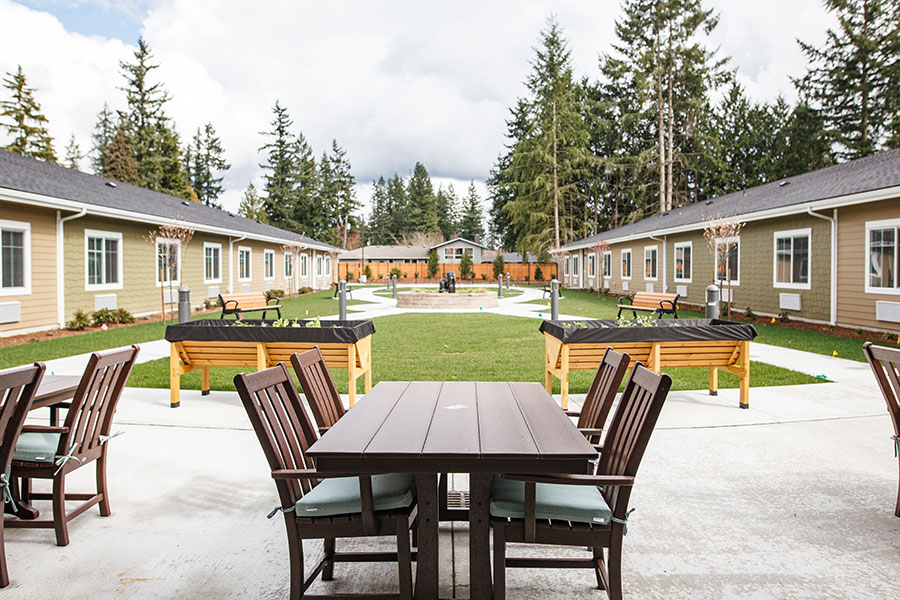
But when it comes to memory care, a move can help some couples return to the roles that existed before cognitive decline. Scott Ernst, Community Relations Director at Fieldstone of Marysville, emphasizes that it does not mean that one spouse is abandoning the other—quite the opposite, in fact. While regulations require that anyone living in memory care must have a dementia diagnosis, the staff and amenities at Fieldstone of Marysville support the continuation of loving, supportive spousal relationships. They welcome spouses to participate in meals and activities as often as they’d like.
“Everyone loves their partner,” Ernst said, “but sometimes they forget about themselves and how you can’t pour from an empty cup.”
Scott has personal experience as a family caregiver himself, so he knows that burnout is real. When he talks to families, it’s from a place of understanding where they are at.
“Being a family caregiver is not only challenging, it’s emotionally taxing,” Ernst said.
That’s especially true when it comes to the unique emotions that come with cognitive decline. Just like in the aforementioned movie, giving the day-to-day caretaking tasks over to professional health care providers allows the spousal caregiver to return to their original role of being a husband or wife. Providing that kind of support is something that Fieldstone of Marysville staff pride themselves on.
“I love helping families, Ernst said. “It’s all about connectedness and helping that family become joyful and vibrant.”
The gift of planning ahead
Couples who begin planning before a health crisis forces the decision often have the greatest flexibility, the widest range of choices, and more time to navigate the transition together. Even when one spouse moves into memory care, that preparation can help preserve connection and create a supportive path forward for both people.
Fieldstone of Marysville understands that couples deserve to have the choice to write the rest of their story together, with the support to do it well. Reach out to us to take a tour and learn how compassionate memory care can help your loved one thrive while supporting both of you through the next chapter of your story.